
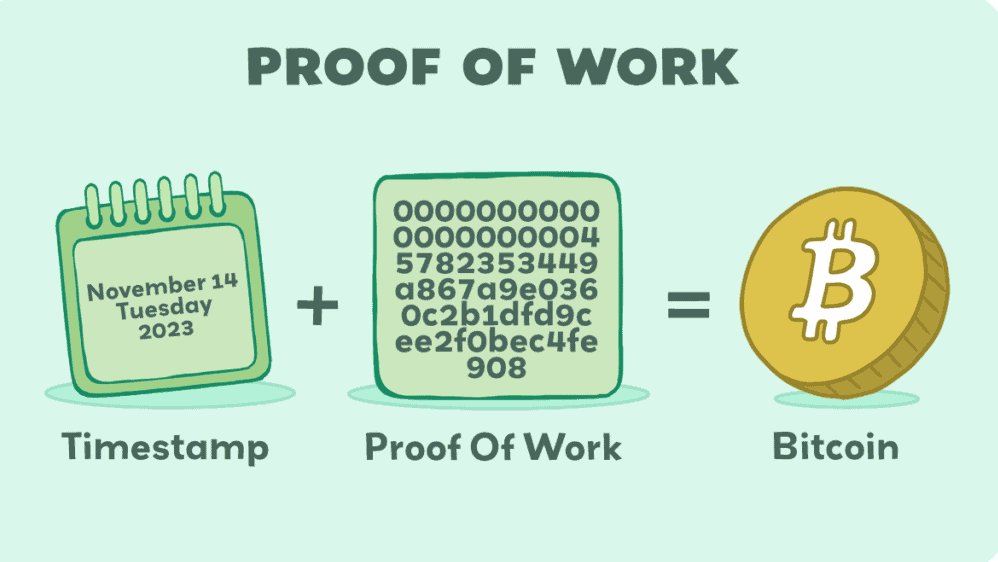
Proof of Work (PoW) is one of the foundational consensus mechanisms that powers many cryptocurrencies, including Bitcoin. It plays a critical role in ensuring blockchain security and decentralization. This article explores what PoW is, how it functions, and its impact on the blockchain ecosystem.
The Origins of Proof of Work
The concept of Proof of Work was first introduced in 1993 by researchers Cynthia Dwork and Moni Naor to combat spam and prevent system abuse. It required users to solve computational puzzles before sending data, making large-scale attacks on systems expensive and inefficient. In 2008, Satoshi Nakamoto adapted PoW for Bitcoin, using it to secure the blockchain and solve the double-spending problem. This adaptation made PoW central to the functioning of Bitcoin and other cryptocurrencies that followed.
How Proof of Work Operates
In a PoW system, miners compete to solve complex mathematical puzzles, which require significant computing power. This process is essential for validating transactions and adding new blocks to the blockchain.
The Mining Process
When users send cryptocurrency, their transactions are grouped into a block. However, before this block can be added to the blockchain, miners must verify it by solving a cryptographic problem. Miners do this by repeatedly attempting to find a specific hash value that meets the conditions set by the network. This process, known as hashing, involves numerous trial-and-error attempts.
The difficulty of the task adjusts based on the total computational power of the network to ensure that blocks are added at regular intervals, such as every 10 minutes in the Bitcoin network. Once a miner solves the puzzle, the solution is shared with the network. Other nodes verify the solution, and if it’s correct, the block is added to the blockchain. The miner who solved the puzzle is rewarded.
Rewards in PoW Systems
Miners in PoW-based systems receive two types of rewards:
-
Block Reward: Each time a new block is added to the blockchain, the miner who solved the puzzle is rewarded with newly created cryptocurrency. In the case of Bitcoin, this is known as the "block reward." However, the amount of the reward decreases over time through a process called "halving," which happens approximately every four years.
-
Transaction Fees: In addition to the block reward, miners also collect transaction fees from users. These fees are a small amount added to each transaction. Over time, as block rewards decrease, transaction fees are expected to become a more significant portion of miners’ income.
Factors Influencing PoW Mining Complexity
Several factors affect the complexity of PoW mining:
-
Number of Miners: As more miners join the network, the overall computational power increases. This makes it easier to solve cryptographic puzzles, which could speed up block creation. To maintain a consistent block creation time, the network automatically adjusts the difficulty, making the puzzles harder as the number of miners grows.
-
Block Creation Time: PoW blockchains aim to add new blocks at a steady rate. For example, in Bitcoin, the target is to add a new block approximately every 10 minutes. If blocks are being found too quickly due to increased mining power, the difficulty increases. Conversely, if blocks are being found too slowly, the difficulty decreases. This mechanism ensures that the blockchain maintains a predictable flow of new blocks.
-
Difficulty Adjustments: PoW networks regularly adjust the difficulty of mining based on the total computational power. In Bitcoin, this adjustment happens every 2016 blocks, or roughly every two weeks. This ensures a balance between increasing network power and the time it takes to find new blocks.
The Impact of Computational Complexity
Computational complexity in PoW systems serves several purposes. It ensures that adding new blocks to the blockchain requires significant effort, which in turn secures the network against attacks, such as the 51% attack. However, as the complexity increases, mining becomes more resource-intensive, leading to higher energy consumption and costs. This has raised concerns about the environmental impact of PoW systems, as well as the risk of mining centralization, where only large entities with access to powerful hardware can profitably mine.
Popular Cryptocurrencies Using PoW
Several well-known cryptocurrencies rely on the PoW consensus mechanism. Some of the most prominent include:
-
Bitcoin (BTC): As the first and most widely adopted cryptocurrency, Bitcoin uses PoW to validate transactions and secure its blockchain. Miners solve cryptographic puzzles to add new blocks and are rewarded in BTC. The process of halving occurs every four years, gradually reducing the number of new coins issued.
-
Bitcoin Cash (BCH): A fork of Bitcoin, Bitcoin Cash was created to address scalability issues. It uses the same PoW algorithm as Bitcoin but has a larger block size, allowing for faster transaction processing and lower fees.
-
Litecoin (LTC): Developed as an alternative to Bitcoin, Litecoin is often referred to as "digital silver." It uses a different PoW algorithm called Scrypt, which is less resource-intensive than Bitcoin’s SHA-256, making it more accessible to a wider range of miners.
-
Dogecoin (DOGE): Originally started as a joke, Dogecoin has since gained widespread popularity for fast and low-fee transactions. It uses the same Scrypt-based PoW algorithm as Litecoin, allowing for "merge mining," where miners can work on both networks simultaneously.
Advantages and Disadvantages of Proof of Work
Proof of Work has several key advantages. It provides a high level of security for blockchain networks due to the complexity of the cryptographic puzzles that miners must solve. This makes it difficult and costly for attackers to manipulate the blockchain, ensuring the integrity of transactions.
However, PoW systems also face significant drawbacks. Mining is energy-intensive, consuming large amounts of electricity, which has led to concerns about the environmental impact of PoW-based cryptocurrencies. Additionally, as the difficulty of mining increases, only miners with access to advanced hardware can remain competitive, leading to the risk of centralization where a few large players control the majority of mining power.
The Future of Proof of Work
The future of PoW is the subject of ongoing debate, especially given the rising energy costs and environmental concerns associated with it. Many newer blockchain projects are moving toward alternative consensus mechanisms, such as Proof of Stake (PoS), which is more energy-efficient and scalable. However, PoW remains a crucial component of established networks like Bitcoin, which prioritize security and decentralization.
Efforts to make PoW more sustainable are also being explored, including using renewable energy sources for mining and developing more energy-efficient hardware. These innovations could play a critical role in the long-term viability of PoW.
Alternatives to Proof of Work
One of the most widely adopted alternatives to PoW is Proof of Stake (PoS), where participants validate transactions by locking up their cryptocurrency as collateral, rather than using computational power. This reduces energy consumption and increases the network’s scalability. PoS is used in newer projects like Ethereum 2.0 and Cardano.
Other alternatives include Delegated Proof of Stake (DPoS), where users vote for a small group of validators, and Proof of Authority (PoA), where validators are chosen based on their reputation. These systems offer better scalability and lower costs but may compromise decentralization.
Conclusion
Proof of Work is a time-tested consensus mechanism that has been fundamental to the development of blockchain networks like Bitcoin. While it provides high levels of security and decentralization, PoW systems also face challenges related to energy consumption and mining centralization. As blockchain technology continues to evolve, PoW may hybridize with other consensus models or adopt more sustainable practices to address these issues, ensuring its relevance in the future of decentralized networks